
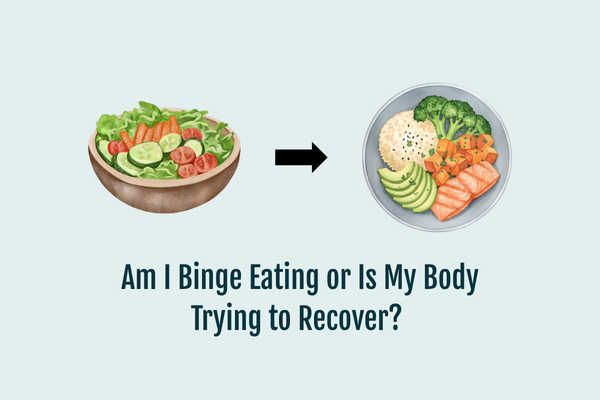
Am I Binge Eating or Is My Body Trying to Recover? Understanding the Difference Between Emotional Eating and Physiologic Hunger
Written by: Sophia Schweiger
Reviewed by: Andrew Wade, MS, RDN, LDN, CSSD
You eat “healthy” all day. Maybe you had a salad for lunch, skipped an afternoon snack, or you had a busy day and pushed back dinner. Then suddenly, it’s night time, and the cravings hit. Anything carbohydrate-heavy feels impossible to ignore: cereal, bread, crackers, cookies, granola, chips. Afterward, guilt often follows: “Why can’t I control myself?” or “Why do I keep binge eating?”.
However, sometimes, what feels like a binge is actually the body responding to low energy availability. Not all intense hunger is emotional, and not all nighttime eating reflects loss of control.
In many cases, it is the body doing exactly what it is designed to do: restore energy balance. Therefore, understanding the difference between physiologic hunger and emotional eating can reduce shame and support a more accurate interpretation of what your body is signaling.
Not All Intense Hunger Is Emotional
Strong, urgent cravings—especially at night—are often misinterpreted as emotional eating or “lack of control.” Biologically, they can reflect under-fueling.
When intake is consistently low (skipped meals, low carbohydrate intake, high activity, or chronic stress), glycogen stores begin to deplete. Since glycogen is the body’s primary stored form of carbohydrate, this can trigger a strong drive to restore energy quickly.
This may feel like:
- Intense cravings for carbohydrate-rich foods
- Feeling physically full but still unsatisfied
- Persistent or intrusive food thoughts
- Increased hunger in the evening
- Eating more than usual after restriction or activity
This response is not a lack of discipline, but it is a protective biological mechanism.
What Is Physiologic Hunger?
Physiologic hunger is the body’s need for energy.
It commonly develops after:
- Skipping or delaying meals
- Restrictive or low-carbohydrate eating
- Increased exercise or activity
- High stress or demanding schedules
Carbohydrates play a key role in this process because they replenish glycogen and support brain and muscle function.
When energy intake is consistently insufficient earlier in the day, hunger often intensifies later—particularly in the evening when the body “catches up.”
The “Carb Crash” Cycle
A common pattern looks like this:
- Intake is low or inconsistent during the day
- Glycogen stores gradually decrease
- Strong evening cravings emerge
- Large intake occurs at night
- Guilt or discomfort follows
- Restriction increases the next day
- The cycle repeats
This is often misread as needing more control, when it is actually a sign of inconsistent fueling.
What Is Emotional or Psychological Eating?
Emotional eating is different from physiologic hunger, although the two can overlap.
Psychological or emotional eating usually involves using food to cope with emotions such as:
- Stress
- Anxiety
- Loneliness
- Boredom
- Sadness
- Comfort-seeking
- Emotional overwhelm
Food may provide temporary relief, distraction, soothing, or numbness.
Importantly, emotional eating is not a personal failure either, and should not be accompanied with shame. Humans naturally connect food with comfort, pleasure, and emotional experiences. Additionally, during eating, neurotransmitters such as serotonin and dopamine increase, reinforcing reward and satisfaction pathways in the brain, contributing to feelings of pleasure and contentment.
And in many cases, restriction itself can increase emotional eating behaviors. When the body is undernourished, emotions around food often become stronger and more distressing. This is why it’s important not to oversimplify the conversation. Physiologic hunger and emotional eating are not always completely separate experiences.
Physiologic Hunger vs. Emotional Eating
While the two can overlap, they often differ in pattern:
Physiologic hunger
- Follows under-fueling or activity
- Feels urgent and physical
- Often carbohydrate-focused
- Improves with consistent nourishment
Emotional eating
- Linked to emotional states
- More variable in food choice
- Often seeks comfort or distraction
- May not resolve with physical fullness alone
Signs You May Need More Fuel
Your body may be asking for more consistent nourishment if you notice:
- Strong nighttime cravings
- Repeated carbohydrate cravings
- Feeling physically full but still unsatisfied
- Missing or delaying meals
- Increased hunger after active days
- Food preoccupation during stress
- Waking up hungry or eating at night
It is important to note that stress also increases energy demands and can unintentionally reduce intake throughout the day.
What Helps?
Instead of responding to intense hunger with restriction, focus on consistency:
- Eat regularly throughout the day
- Include carbohydrates at meals
- Add snacks or increase carbs on active or busy days
- Avoid long gaps without eating
- Fuel before and after exercise
- Notice patterns between stress, activity, and hunger
Even small increases in daytime intake can significantly reduce nighttime cravings.
A helpful reframe:
Instead of:
“I try to have self control, but I keep binge eating at night. I don’t know what is wrong with me.”
Try:
“My body may have needed more fuel today than I realized.”
That shift alone can reduce guilt and help rebuild trust with your body!
The Bottom Line
Large appetite or nighttime eating is not automatically a sign of disordered behavior. In many cases, it reflects the body restoring energy after periods of under-fueling, stress, or restriction.
Understanding the difference between emotional eating and physiologic hunger can help reduce guilt and rebuild trust with your body.
If this feels familiar, working with a registered dietitian can help clarify your body’s needs and support a more consistent, sustainable eating pattern. Get matched with your Case Specific dietitian in 5 clicks at casespecificnutrition.com/match. Our team provides individualized nutrition care throughout the Greater Pittsburgh area, with dietitians serving clients in East Liberty, Mt. Lebanon, the North Hills, Plum, Robinson, and Upper St. Clair–Peters Township, as well as in Erie, Altoona, and Raleigh.
Looking for more practical, evidence-informed nutrition and wellness guidance? Check out The Case Specific Podcast, where CEO and founder Andrew Wade, along with other CSN dietitians, discuss nutrition, health, fitness, and wellness; break down the science behind common nutrition questions; and share practical strategies you can use in everyday life. Listen to The Case Specific Podcast on our website, watch on YouTube, or listen on Spotify.
For more nutrition tips, educational content, team updates, and the latest from Case Specific Nutrition, follow us on Instagram and connect with us on LinkedIn.

.avif)
.webp)

