
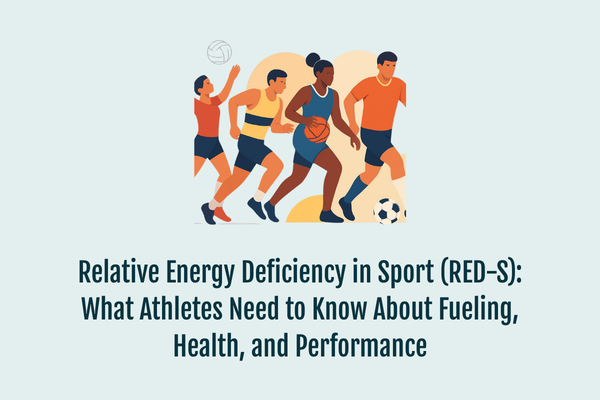
Relative Energy Deficiency in Sport (RED-S): What Athletes Need to Know About Fueling, Health, and Performance
Written by: Sophia Schweiger
Reviewed by: Andrew Wade, MS, RDN, LDN, CSSD
In sports nutrition, you often see athletes who are training consistently, eating what they consider a “healthy” diet, and still feeling stalled in their progress. They may report persistent fatigue, slower recovery, recurrent injuries, mood changes, or a sense that their performance no longer matches their effort.
In many of these cases, the underlying issue is not motivation or discipline, but inadequate fueling.
One increasingly recognized framework for understanding this pattern is Relative Energy Deficiency in Sport (RED-S).
This blog will walk through what RED-S is, why it occurs, how it affects the body, and what appropriate treatment and prevention look like from a sports dietetics perspective.
The Core Issue: Low Energy Availability (LEA)
At the center of RED-S is low energy availability (LEA).
Energy availability refers to the amount of dietary energy remaining for normal physiological function after accounting for exercise energy expenditure. In simplified terms:
- Energy Availability = Energy Intake – Exercise Energy Expenditure (relative to fat-free mass)
When intake does not sufficiently cover both training demands and basic physiological needs, the body adapts by conserving energy. This conservation affects systems not essential for immediate survival but critical for long-term health and athletic performance.
For female athletes, clinical symptoms often appear when energy availability falls below approximately 30 kcal/kg fat-free mass (FFM) per day. Optimal energy availability is generally considered to be ≥45 kcal/kg FFM per day, although individual variability exists and research continues to evolve.
Importantly, LEA can occur:
- Intentionally (e.g., weight loss efforts, body composition goals)
- Unintentionally (busy schedules, lack of nutrition knowledge)
- During periods of increased training without a corresponding increase in intake
- In the presence of psychological stress
- With rigid “clean eating” patterns that limit total energy
An athlete does not need to have an eating disorder to develop RED-S.
Physiological Consequences of RED-S
As mentioned earlier, insufficient energy intake triggers adaptive physiological responses that suppress non-essential functions in order to conserve energy for vital processes. Chronic low energy availability leads to measurable changes across multiple bodily systems.
Bone Health
One of the most well-documented consequences is impaired bone health. LEA suppresses reproductive and metabolic hormones that are protective for bone mineral density. Over time, this can increase the risk of:
- Stress fractures
- Decreased bone mineral density
- Delayed bone healing
For athletes in high-impact sports, this risk is particularly concerning.
Endocrine (Hormonal) Function
Energy deficiency disrupts multiple hormonal pathways:
- Suppression of estrogen in females and testosterone in males
- Altered luteinizing hormone and follicle-stimulating hormone
- Reduced thyroid hormone (particularly T3)
- Decreased leptin levels
- Reduced resting metabolic rate
In females, menstrual irregularities or amenorrhea are common clinical signs. In males, low testosterone may manifest as reduced libido, fatigue, or impaired recovery.
Cardiovascular Health
Emerging research suggests LEA may influence cardiovascular function through:
- Altered lipid profiles (e.g., increased LDL, decreased HDL)
- Increased sympathetic tone
- Impaired vasodilation
- Reduced cardiac muscle mass in severe cases
While these changes are often reversible with adequate fueling, they underscore that RED-S is not limited only to performance outcomes.
Immune Function
Low energy availability is associated with:
- Impaired cell-mediated immunity
- Increased pro-inflammatory cytokines
- Greater susceptibility to infections
- Delayed wound healing
Athletes may notice they “get sick more often” during heavy training blocks, particularly when they haven’t adjusted their energy intake.
Psychological Effects
Energy deficiency can also influence mental health:
- Increased anxiety or depressive symptoms
- Irritability
- Difficulty concentrating
- Reduced overall well-being
These effects may further complicate recovery if not addressed within a comprehensive care plan.
Performance Implications
From a sports perspective, the performance consequences are often what bring athletes into care:
- Decreased strength and power
- Reduced endurance capacity
- Impaired muscle protein synthesis
- Slower recovery between sessions
- Increased injury risk
- Decreased coordination and decision-making
Athletes may interpret these changes as a need to train harder, when the more appropriate intervention is improved fueling.
Identifying Athletes at Risk
Certain populations are at higher risk, including:
- Endurance athletes
- Athletes in aesthetic or weight-class sports
- Sports with frequent weigh-ins
- Environments that emphasize leanness
- Teams with strong “win at all costs” cultures
However, any athlete increasing training load without adjusting energy intake is at risk.
Nutrition Intervention: Restoring Energy Availability
The first step is identifying and addressing the cause of low energy availability. For many female athletes, restoring intake to ~45 kcal/kg FFM/day may require 2,400–2,600+ kcal/day, depending on body size and training load.
Macronutrient targets:
- Carbohydrates: 4–6 g/kg (higher during intense training)
- Protein: 1.5–1.8 g/kg
- Fats: Remaining calories to support energy and hormonal function
Adequate carbohydrates are critical, as low intake may impair iron metabolism and immune function. Attention should also be given to iron, calcium, vitamin D, B vitamins, and essential fatty acids.
Nutrition timing: eat within 30–60 minutes post-training, avoid gaps >4 hours, and periodize intake to match training demands.
The Role of the Sports Dietitian
At Case Specific Nutrition, sports dietitians provide individualized, performance-focused nutrition support. Our role includes:
- Assessing energy availability and fueling patterns to support training, recovery, and competition.
- Designing personalized nutrition plans that optimize recovery, body composition, and overall health.
- Educating athletes and coaches on practical strategies for fueling, hydration, and timing.
- Supporting sustainable behavior change and addressing barriers such as time, access, or resources.
- Collaborating with strength coaches, trainers, and other healthcare professionals to ensure nutrition strategies align with the athlete’s overall training and well-being.
Case Specific emphasizes a tailored, evidence-based approach that combines mindset, habits, and science to help athletes reach peak performance.
If you suspect under-fueling may be contributing to your symptoms, get matched with your Case Specific dietitian in 5 clicks at casespecificnutrition.com/match. Our team provides individualized nutrition care throughout the Greater Pittsburgh area, with dietitians serving clients in East Liberty, Mt. Lebanon, the North Hills, Plum, Robinson, and Upper St. Clair–Peters Township, as well as in Erie, Altoona, and Raleigh.
Looking for more practical, evidence-informed nutrition and wellness guidance? Check out The Case Specific Podcast, where CEO and founder Andrew Wade, along with other CSN dietitians, discuss nutrition, health, fitness, and wellness; break down the science behind common nutrition questions; and share practical strategies you can use in everyday life. Listen to The Case Specific Podcast on our website, watch on YouTube, or listen on Spotify.
For more nutrition tips, educational content, team updates, and the latest from Case Specific Nutrition, follow us on Instagram and connect with us on LinkedIn.

.avif)
.webp)

