
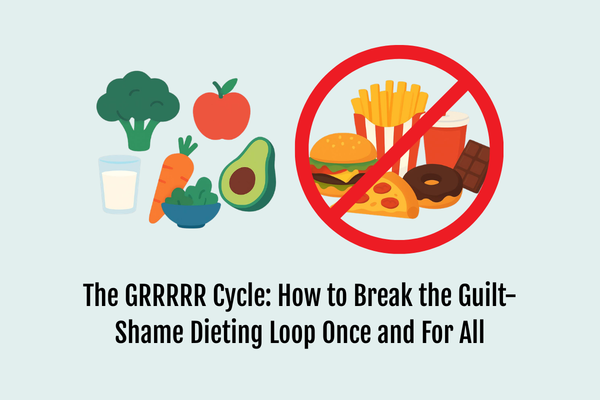
The GRRRRR Cycle: How to Break the Guilt-Shame Dieting Loop Once and For All
Written by: Sophia Schweiger
Reviewed by: Andrew Wade, MS, RDN, LDN, CSSD
Have you ever felt like you know what to do when it comes to eating, but can’t seem to follow through long‑term? The truth is that many individuals don’t lack nutrition knowledge or motivation. What they’re actually stuck in is a pattern that looks like personal failure, but is really a predictable response to restriction.
At Case Specific Nutrition, we call this pattern the GRRRRR Cycle. It shows up quietly, repeats relentlessly, and is often reinforced by well‑intentioned diet culture messages. Understanding this cycle is one of the most important steps toward building a healthier, more sustainable relationship with food.
What Is the GRRRRR Cycle?
The GRRRRR Cycle describes what happens when eating is driven by rigid rules instead of internal cues, context, and flexibility. It often looks like this:
Gain – Weight gain or feeling off‑track. This doesn’t have to mean significant weight gain; sometimes it’s simply feeling “not great” in your body.
Restrict – In response, strict rules are put in place, foods are eliminated, and portions shrink. Language like “I can’t have…”or “I’m done with…” takes over.
Resent – Over time, restriction creates deprivation. The foods that are off‑limits are often the ones you genuinely enjoy, or that are tied to social moments, traditions, or comfort. Resentment builds toward the rules, the food, or yourself.
Rebel – Eventually, the pendulum swings. This might look like eating far past comfort, feeling out of control, or consuming foods in isolation that were previously restricted. What’s often labeled a “binge” is frequently the body and brain reacting to prolonged restriction.
Regret – Guilt, shame, and harsh self‑talk follow. Language like “I always do this.” or “I can’t be trusted around this food.” creeps up. The focus turns inward, and confidence diminishes once again.
Repeat – To compensate, rules tighten and the cycle begins again.
Why Restriction Keeps Fueling the Cycle
Diet culture tends to frame health as a matter of discipline and willpower. However, the reality is that rigid food rules often work against both physical and psychological regulation. Restriction increases cravings, causing our mind to be fixated on these foods. Labeling foods as “good” or “bad” assigns moral value where none exists, and over time, eating becomes stressful instead of supportive.
A crucial misunderstanding is that many people come to believe that the food is the problem. However, the issue is rarely the food itself, but it’s how, when, and why the food is being eaten. There is no wagon to fall off. Eating is a continuous series of decisions, and no single choice cancels out the rest.
Abstinence vs. Moderation
A common theme we see in the GRRRRR Cycle is an all‑or‑nothing approach to eating.
Abstinence‑style eating relies on strict rules:
- No exceptions allowed
- One “off” choice feels like failure
- Often leads to overeating later
Moderation‑based eating, on the other hand, allows for flexibility:
- Allows intentional exceptions
- Enjoyment without guilt
- Easier to return to routine
Life is full of exceptions: celebrations, travel, shared meals, cultural traditions. When these moments are treated as set-backs instead of part of a normal eating pattern, the cycle tightens. When they’re treated as exceptions within a stable foundation, they lose their power.
Shifting the Focus: From What You Eat to How You Eat
One of the most impactful reframes is moving away from “Eat this, not that” thinking and toward understanding how food functions in your body.
Instead of asking:
- Is this food allowed?
- Is this good or bad?
Try asking:
- What does this food give me—energy, fullness, enjoyment, comfort?
- How is this food best eaten to support me?
Health is not built through elimination. It’s built through combination, context, and relationship.
Food as Puzzle Pieces
Rather than dividing foods into moral categories, think of food in terms of function:
- Regulating foods (protein, fiber‑rich foods) support fullness and hunger regulation.
- Energizing foods (carbohydrates and fats) fuel the brain, muscles, hormones, and immune system.
- Enhancing or fun foods (desserts, sweets, snack foods) add enjoyment and satisfaction.
No single category creates health on its own. Balance comes from pairing. For example, foods that tend to feel “out of control” are often eaten alone, on an empty stomach, or in response to deprivation. Changing the context rather than eliminating the food can completely change the experience. It’s not that you can’t eat certain foods. It’s that they aren’t meant to be eaten in isolation.
Breaking the Guilt–Shame Loop
A major driver of the GRRRRR Cycle is the internal dialogue that follows eating. Guilt and shame don’t “keep you on track”, they keep you in the cycle.
Instead of:
- “I was bad.”
- “I failed.”
- “I can’t be trusted around this food.”
Try:
- “That was an exception.”
- “This doesn’t define my habits.”
- “I can return to my normal pattern.”
Being conscious of negative self-talk and discouraging mindset patterns is crucial in breaking the cycle. Even subtle mindset shifts or positive affirmations can help soften inner dialogue and restore peace in a space that was once shame-ridden.
The Bottom Line
If you see yourself in the GRRRRR Cycle, you are not broken, your body is not the enemy, and your willpower is not the issue. Rigid food rules create fear, guilt, and disconnection from the mind-body experience of eating. Confidence with food comes from learning how to eat, not from avoiding foods altogether. At its core, this work is about restoring trust: in your body, in your choices, and in your ability to nourish yourself in a way that supports both physical health and peace of mind.
Let’s break the cycle together. Get matched with your Case Specific dietitian in 5 clicks at casespecificnutrition.com/match. Our team provides individualized nutrition care throughout the Greater Pittsburgh area, with dietitians serving clients in East Liberty, Mt. Lebanon, the North Hills, Plum, Robinson, and Upper St. Clair–Peters Township, as well as in Erie, Altoona, and Raleigh.
Looking for more practical, evidence-informed nutrition and wellness guidance? Check out The Case Specific Podcast, where CEO and founder Andrew Wade, along with other CSN dietitians, discuss nutrition, health, fitness, and wellness; break down the science behind common nutrition questions; and share practical strategies you can use in everyday life. Listen to The Case Specific Podcast on our website, watch on YouTube, or listen on Spotify.
For more nutrition tips, educational content, team updates, and the latest from Case Specific Nutrition, follow us on Instagram and connect with us on LinkedIn.
.avif)
.webp)

